Sales Cadences: Best Practices, Templates, and Tools
Learn how to build a sales cadence from scratch. Get proven sales cadence examples, timing best practices, and the best tools to automate your personalized outreach.


80% of sales require 5 or more follow-ups to close, but 44% of sellers give up after making just one follow-up attempt.
Sales teams are winging it, firing off email after email to try to make quota. That’s not a go-to-market (GTM) strategy, though. You can’t run a sales motion off a gut feeling and sticky notes.
The sales cadence is your antidote to chaotic outreach. It forces execution, prevents deals from slipping through the cracks, and ensures reps are actually doing the high-impact work that generates revenue.
Here’s everything you need to know about building, measuring, and optimizing sales cadences.
What is a Sales Cadence?
A sales cadence is a structured, sequential schedule of outreach activities designed to connect with a prospect and secure a meeting.
In a cadence, touches typically include:
- Emails
- Phone calls
- Social media interactions
The cadence itself is a playbook, dictating exactly what a sales rep should do, which channels they can activate, and on what day they should execute the action.
But before you write every email, make every phone call, or compose every LinkedIn message yourself: What if your revenue platform built and personalized every cadence?
That’s Reevo, eliminating all the work sellers forget to do or just don’t have time for, pulling together the context needed for a relevant touch with a prospect.
How to Build a Sales Cadence: Step-by-Step Guide
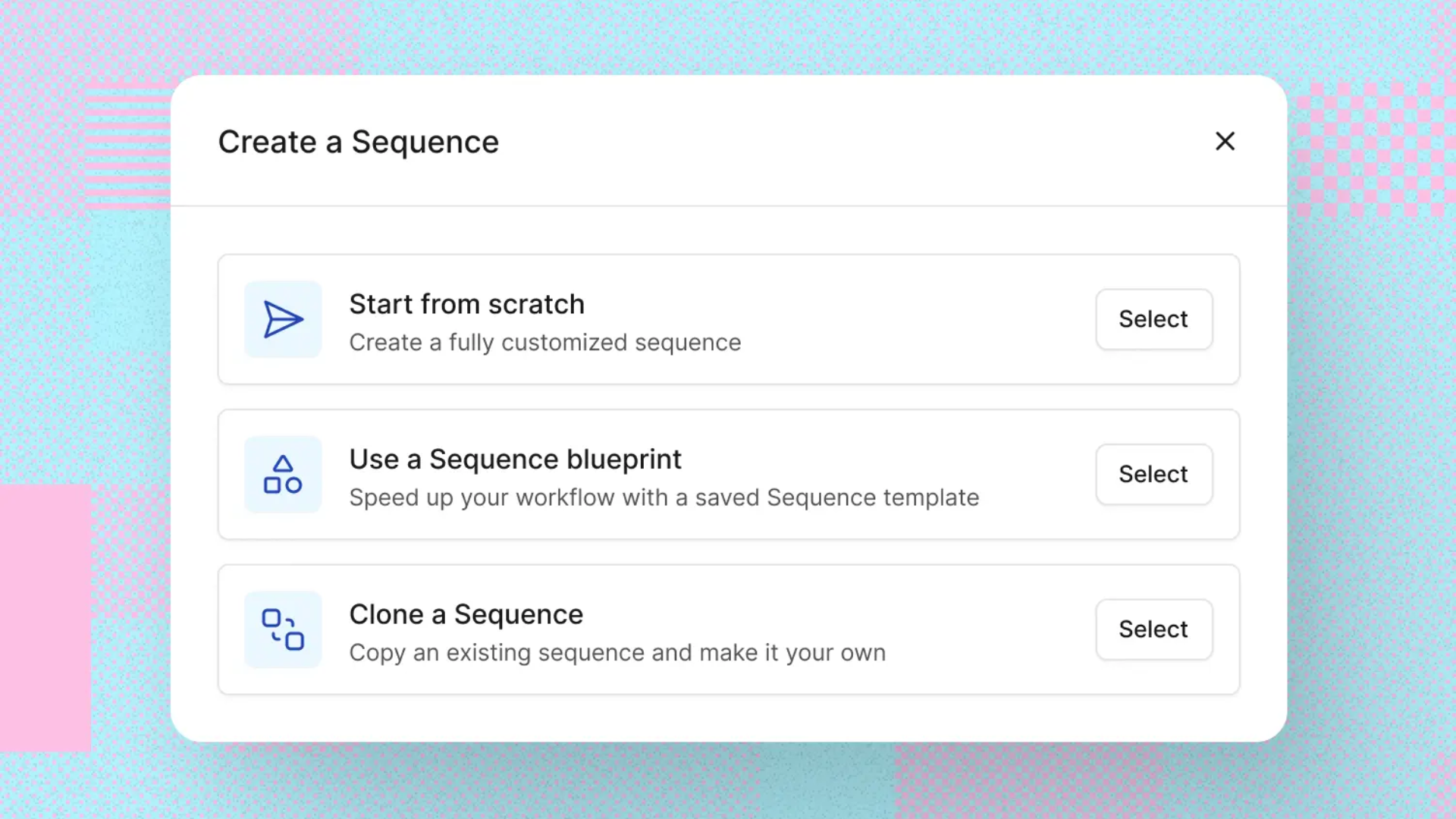
Building a winning sales cadence isn’t done by guessing how many emails to send and hoping enough prospects reply.
The strongest cadence starts with the buyer, the intent signal, and the outcome you want from the interaction. Then you reverse-engineer the right mix of timing, channels, and messaging to create sales sequences that convert.
Here’s how to build a sales cadence that every rep can execute.
Step 1: Define Audience & Intent
An inbound demo request requires a wildly different cadence than a cold outbound prospect. Group your lists by intent.
If someone just downloaded your pricing guide, they have high intent. Your cadence should hit them immediately and intentionally over a short period.
But if you’re cold prospecting into an enterprise account, the intent is zero. Your cadence needs to be a slow burn designed to educate and build authority over several weeks.
Step 2: Choose Channels
Buyers are overwhelmed, receiving about 15 cold emails weekly. So don’t rely entirely on the inbox.
What channels should you use in your outreach cadence? A healthy mix of email, phone, and LinkedIn.
Multi-touch outreach can create up to 287% higher engagement than single-channel outreach.
Step 3: Map Out Timing
The timing between your outreach attempts dictates your success rate.
How many emails should you send in a sales cadence? Usually, 4 to 6 emails mixed with 3 to 4 calls.
But spacing matters. Data shows that cadences with 1-2 days between attempts perform better than week-long gaps.
If you contact the prospect twice on Monday and then wait two weeks to follow up, you lose all momentum. Create a tight, logical rhythm that keeps you top of mind without becoming a daily nuisance.
Step 4: Write Contextual Messaging
Relying on generic “Just bubbling this to the top of your inbox” adds zero value and annoys the buyer.
Every touch should provide a new perspective. Here’s an example:
- Touch 1 focuses on a specific pain point.
- Touch 2 offers a case study resolving that pain.
- Touch 3 pivots to a completely different bottleneck.
You’re going to get blocked if you just repeat, “Did you see my last email?”
Sales Cadence Best Practices for 2026
You’ve built your sales cadence. Next up: driving pipeline, and your execution has to be flawless.
Keep these best practices in mind before you launch your next sales cadence:
- Don’t stop at the fourth touch: Generating a viable sales lead takes about 6 to 8 touches, according to research. If your cadence is only 3 emails long, you’re quitting right before the statistical breakthrough.
- Lead with the phone: Emails get lost in the noise. Calls demand immediate attention and build trust; people buy with trust, even at higher prices. If the prospect doesn’t answer, a voicemail paired with a well-timed email still dramatically increases your reply rate.
- Personalize the first touch, automate the rest: You can’t write 50 emails a day and expect to scale, so let the sales cadence software automate your follow-ups.
3 Sales Cadence Examples & Templates
The ‘right’ sales cadence depends on the prospect’s intent, buying stage, and familiarity with your brand or product. An inbound lead who requested a demo shouldn’t get the same outreach as a cold enterprise account that has never heard of you.
Use these sales cadence templates as starting points, adjusting them based on deal size, persona, and urgency.
1. 8-Day High-Velocity Inbound Cadence
Most inbound cadences drag on, including 8-12 touches over 10-15 business days. But speed to lead is critical.
Highly effective sales cadences typically last only 8 days, earning an eye-opening 79.4% success rate through 6 to 7 high-touch, multi-channel attempts.
- Day 1: Send an automated email with immediate context on what the prospect downloaded, and make a phone call.
- Day 2: Send a value-add email that shares a relevant case study.
- Day 4: Make a phone call (and leave a voicemail), then send a LinkedIn connection request.
- Day 6: Send a short, question-based email checking on a specific pain point.
- Day 8: Make a phone call and send a breakup email that gives the prospect permission to let you move on.
2. Multi-Channel Cold Outreach Cadence
Cold outreach cadences usually include 6-8 touches distributed evenly across email, phone, and social media. Intent is low, so you need to spread the spacing out slightly to avoid looking like spam.
- Day 1: Send a highly personalized email, and view the prospect’s LinkedIn profile (but don’t connect yet).
- Day 3: Make a phone call, but don’t leave a voicemail yet.
- Day 5: Send a threaded follow-up email that provides a micro-case study.
- Day 7: Make a phone call and leave a curiosity-driven, 20-second voicemail.
- Day 10: Send a LinkedIn connection request and reference the voicemail.
- Day 13: Send an “Any thoughts?” bump email.
- Day 16: Make a phone call, and send a breakup email.
3. Slow Burn Cadence
Some deals are larger and require finesse, particularly in enterprise sales, so the cadence spans 21 to 30 days (if not longer) and relies entirely on deep research.
- Day 1: Send a personalized email referencing the company’s recent news.
- Day 5: Make a phone call introducing yourself.
- Day 9: Send a value-add email that shares an ungated industry benchmark report.
- Day 14: Comment on the prospect’s LinkedIn post, or tag them in a comment on another post.
- Day 18: Make a phone call and leave a highly specific voicemail.
- Day 22: Send an email pivoting the pain point to a new angle.
- Day 28: Send a breakup email that leaves the door open for next quarter.
When Should You Give Up on a Prospect?
In every deal, there are two winners: the person who wins the contract, and the person who knows when to cut bait and get out. Everyone wants to close a deal, but it’s just as important to preserve your time when you know it’s not going to work out.
Here’s a good stopping point: Once you’ve hit 12 touches across multiple channels and are getting total silence, it’s time to move on from a prospect.
You’re wasting active selling hours on a ghost by going any further. Transfer the prospect into a long-term marketing nurture campaign, and shift your energy to pipeline that actually wants to move.
KPIs & Benchmarks to Measure a Sales Cadence
If you’re not tracking any data, you’re just guessing.
Monitor the specific leading indicators of a successful sales cadence:
Metric | What It Measures | Benchmark for Success |
|---|---|---|
Email Open Rate | Are your subject lines actually working? | 25% to 50% |
Email Reply Rate | Is your messaging resonating with the buyer’s | 3% to 5% |
Call Connection Rate | Is your phone data accurate, and are reps calling at the right time? | 4% to 6% |
Meetings Booked Rate | Are cadences generating pipeline? | 1% to 3% |
Email Open & Reply Rates
Open rate tells you if your subject lines look like camouflage or spam, and reply rate tells you if the actual body copy holds any value.
If you have a 70% open rate but a 0.5% reply rate, your subject line is tricking the prospect into opening an email that they’ll hate.
Call Connection Rate
If sales reps are making 100 dials a day and only speaking to two people, your data is broken. A low connection rate means you’re calling bad numbers or navigating impenetrable phone trees.
Meetings Booked Rate
If a specific 14-day cadence is generating a massive amount of replies, but zero booked meetings, it’s failing.
Track pipeline generated by each specific cadence to see which frameworks actually drive revenue.
Best Sales Cadence Software & Tools (2026 Rankings)
Sales cadence software and tools should do more than fire off emails and remind reps to make calls. You need a platform that helps you execute consistent outreach, personalize at scale, track every touch, and connect activity back to pipeline.
Here’s what you should consider using in 2026.
Reevo
Reevo is an AI-native Revenue Operating System that eliminates the need for a 12-tool sales stack.
The platform unifies your entire revenue workflow, from data enrichment to prospecting and sequencing, on one foundation.
Other sales cadence software and tools help reps send more emails. Reevo’s platform, however, runs the entire motion around those cadences, so you find the right accounts to engage buyers with full context and turn activity into pipeline.
- Best for: Sales teams looking to replace their legacy CRM and clunky sequencing with a complete revenue platform that takes you from first touch to closed won without switching tabs.
- Sales cadence killer feature: Every seller can automate multi-channel campaigns to engage prospects, saving time by crafting fully personalized cadences.
- G2 rating: 4.9 out of 5.
When it’s time to actually write an email or make a phone call, you’re not stuck doing all the work behind it. Reevo crafts email drafts and talking points, complete with key facts and details relevant to a specific prospect, so every cadence feels tailored.
The tradeoff with Reevo is that you’re replacing the entire sales stack, which might seem overwhelming at first glance. But it’s worth making the switch: Take a look at Casca and Propel’s experiences with Reevo to get an idea of just how easy it is.
Outreach
Outreach is one of the original players in sales engagement, built specifically to sit atop CRMs and automate complex cadence-based sequencing rules.
- Best for: Large enterprise teams deeply entrenched in Salesforce architectures who need a dedicated, heavy-duty sequencing bolt-on to launch cadences.
- Sales cadence killer feature: Outreach has a sizable integration ecosystem that syncs data across CRM contacts and opportunities with channels like email and LinkedIn.
- G2 rating: 4.3 out of 5.
The tradeoff with Outreach is complexity. If you’re trying to simplify the stack instead of adding another layer on top of your CRM, Outreach can feel like more software to manage rather than less work for sellers.
Salesloft
Salesloft is built to help sales reps manage outbound communication, unlocking a structured way to run prospecting, track engagement, and keep everyone on schedule.
- Best for: Teams looking for a tool to manage email, phone, and LinkedIn touches alongside an existing CRM.
- Sales cadence killer feature: Salesloft organizes multi-channel outreach, automates follow-ups, and tracks engagement across interactions.
- G2 rating: 4.5 out of 5.
The tradeoff with Salesloft is that it still sits inside the sales stack. Teams might get decent cadence execution, but they’ll still need a CRM and separate tools for everything else in a sales motion. Just remember that every API and integration is another challenge.
Here’s Why Most Sales Cadences Fail
Most sales cadences fail because the process breaks down before the email is sent or the phone call is made.
Sales reps are forced to manage cadences manually across a fragmented sales stack. They’re bouncing between a slow CRM, a separate dialer, a disconnected sequencer, scattered meeting notes, and enrichment tools that lack the right data.
Even the best sales cadence template is useless when reps have to research every account, copy notes into a CRM, chase down missing context, and guess what to do next.
One final piece of advice on sales cadences: You need a platform that natively understands the entire sales motion, like Reevo. Get a tour here.
Frequently Asked Questions: Sales Cadences
A force multiplier for sales teams.
Get startedKey takeaways
- 80% of sales require 5 or more follow-ups, but 44% of sellers give up after making just one follow-up attempt
- Sales cadences force execution, prevent deals from slipping, and ensure sellers do high-impact work
- Multi-touch outreach can create up to 287% higher engagement than single-channel outreach
On this page
Get our newsletter, The GTM Source


