Here’s Why APIs & Integrations Ruin a Sales Motion
Let’s explain the technical reality of broken APIs, the illusion of integrations, and why a stackless architecture is the only way to unlock AI for sales.


Every company is rushing to insert AI into the sales process. But nobody talks about the messy data infrastructure required to make it all work.
Sales teams are sold tool after tool, and they all ignore the foundation. Look at how sales and revenue software is actually engineered. Look at the architecture of your sales stack.
If the foundation is cracked, AI will fail. It’s that simple. And for most sales teams, the foundation spreads across point solutions.
You expect the sales stack to run on a unified knowledge base. Instead, everything runs in isolation. That’s because your foundation is built on disjointed software, so the sales motion slows to a crawl before AI even enters.
In a parallel universe, someone perfectly designed your sales stack to work in harmony. Your CRM speaks to your call recorder, your call recorder speaks to your email sequencer, and your data flows flawlessly across your entire screen.
But integrations aren’t that clean. They’re mostly a facade.
You plug in an API key, authenticate an app, and watch a data field populate in your CRM. It feels like magic for a few minutes. But it takes a massive amount of ongoing effort, time, and engineering bandwidth to keep that connection excellent.
APIs break. Data structures change. And syncs fail silently in the background.
You’ve experienced this firsthand. You buy a dozen tools, force them to talk to each other, and end up stuck. You’re forced to spend hours babysitting broken connections and fixing duplicated records.
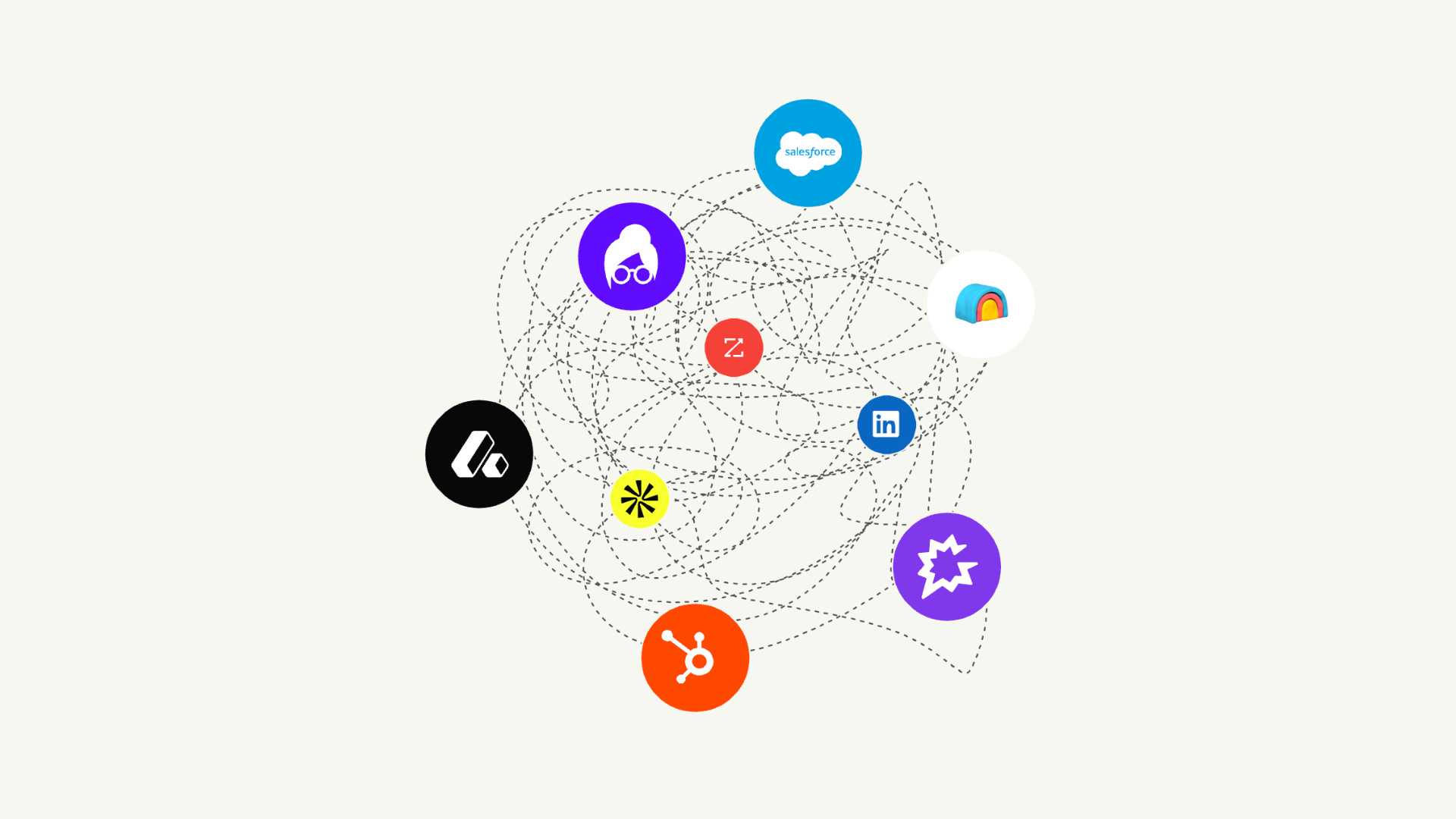
The maintenance overhead of the sales stack is bad, but the resulting data degradation is fatal. When you pass data between tools, you’re never going to get the full picture.
Take a 45-minute discovery call with a prospect. If you’re relying on an API to push that conversation from your standalone meeting intelligence tool into your legacy CRM, you’re instantly losing fidelity.
Sometimes an integration will pass over a decent transcript. But more often than not, system limits force you to settle for a flat text summary. The emotion, the hesitation, and the competitive objections behind any strategy nuance are stripped away.
The limitations dictate exactly what AI can accomplish. When you rely on APIs to transfer knowledge, you’re bottlenecking your own intelligence.
How We Built Reevo’s AI-Native Platform
This deep, structural flaw is exactly why we’ve built a stackless revenue platform. Reevo’s architecture means everything from your CRM to your sequencing to your prospecting all share the exact same intelligence.
There aren’t APIs to manage between GTM functions. The data lives in one platform.
But building this wasn’t just about having call transcripts and email threads housed in the same browser tab. We’re making sure Reevo inherently understands exactly how a specific conversation correlates to the account history, the active opportunity, and the broader pipeline.
First-party data living natively in one place preserves full fidelity: every detail, interaction, and signal.
Treat an AI model similarly to how you treat an employee. You have to give it the right tools, context, and environment to do the job effectively.
Handing AI hundreds or thousands of raw, disconnected call transcripts and asking it to find patterns is inefficient. It lacks the relational context to make sense of the text. We’ve removed those blinders by crafting a unified, stackless architecture. AI has the full picture.
This means that Reevo understands the relationship between an email thread, a call transcript, and an active deal, completing actions far beyond reading and summarizing text.
Reevo can draft personalized follow-ups based on the exact pain points mentioned in a call. It can update pipeline stages or flag churn risk before it happens, based on historical behavioral patterns. The platform actually drives the sales motion forward because all the busywork sellers are usually stuck with is off their plate.
Context, Without All the Complexity
Intelligence requires complete, unbroken context. When you prioritize software complexity over that context, your sales motion breaks down.
Getting rid of the stack is the only way to have clean data, accurate AI, and a clear focus on actually selling.
We’re building Reevo to be the revenue platform that works for you, so the only work you have to do is sell. It’s an exciting moment as we architect this stackless future, and there’s much more to share about what's ahead.
A force multiplier for sales teams.
Get started

