B2B Sales Funnel: Stages, Metrics, and How to Optimize (2026 Guide)
Learn the stages of a B2B sales funnel, the metrics to track, and how to optimize conversion rates. Find out where revenue is leaking and how to fix it, too.


B2B buyers complete as much as 80% of their journey before ever speaking to a sales rep.
This is what they’re doing in the lead-up: reading peer reviews, testing interactive demos, and comparing pricing tiers in private Slack channels. So by the time a prospect finally fills out a demo request and enters your active pipeline, they’ve mostly made up their mind.
If you’re still treating the top of the sales funnel like a sheer numbers game, you’re behind. You can’t throw a list of unverified leads into a sequencer and expect your account executives to sort out the mess.
Capturing revenue in a market where the buyer holds all the power starts with understanding how they navigate your ecosystem. You need to track the right data, identify where prospects are quietly dropping off, and execute flawlessly at every touchpoint.
Here’s what the B2B sales funnel looks like in 2026, the metrics that actually matter, and how to fix the revenue leaks that are costing you deals.
What is a B2B Sales Funnel? (& Why Most Teams Measure It Wrong)
Here’s the definition: A B2B sales funnel is the visual framework representing the sequential journey a prospective buyer takes from their first interaction with a brand to becoming a paying, retained customer.
In theory, the funnel is a perfectly measurable, predictable machine. Marketing pours leads into the top, sales qualifies them in the middle, and closed won revenue drops out the bottom.
In reality, most teams measure their funnel entirely wrong.
When your data is fragmented across a marketing automation platform, a standalone sequencing tool, and a legacy CRM, your ‘funnel’ isn’t a true measurement. It’s an educated guess. You end up with siloed teams arguing over data quality while the buyer experience suffers from disjointed messaging.
Sales Funnel vs Sales Pipeline: What’s the Difference?
You’ll see “sales funnel” and “sales pipeline” used interchangeably, but they measure two different perspectives of the revenue engine.
- The sales funnel tracks the volume and conversion of buyers as they navigate their own journey. It encompasses both marketing and sales, measuring how a broad audience is narrowed down into a specific customer base.
- The sales pipeline tracks the seller’s process. It focuses strictly on activity opportunities, internal deal stages (such as Discovery, Demo, and Negotiation), and the specific dollar value associated with those potential contracts.
The funnel measures the buyer’s actions. The pipeline measures the seller’s execution.
6 Stages of a B2B Sales Funnel
A highly optimized go-to-market (GTM) strategy requires mapping your motions directly to the buyer’s current mindset.
Here are the six stages of the B2B sales funnel:
Sales Funnel Stage | Buyer Behavior | Key GTM Actions | Benchmark Conversion Rate |
|---|---|---|---|
1. Awareness | Researching the symptoms of their problem | SEO blog posts, LinkedIn thought leadership | 2% to 5% (Visitor to Lead) |
2. Interest | Engaging with your brand specifically | Webinars, lead capture forms, initial SDR outreach | 10% to 15% (Lead to MQL) |
3. Evaluation | Self-serve product research | Interactive demos, ROI calculators, case studies | 25% to 30% (MQL to SQL) |
4. Intent | Exhibiting buying signals | Pricing page visits, demo requests, rapid AE follow-up | 20% to 30% (SQL to Opportunity) |
5. Purchase | Negotiating terms and securing internal buy-in | Security questionnaires, proposal reviews, peer references | 20% to 30% (Opportunity to Closed Won) |
6. Retention | Implementing the product and measuring ROI | Onboarding support, QBRs, expansion outreach | 85% (Gross Retention Rate) |
Stage 1: Awareness
In the Awareness stage, the buyer knows they have a problem. But they don’t know the solution, so they’re researching symptoms rather than software categories.
B2B buyers do an average of 12 searches before engaging a specific brand. They’re looking for educational content that validates their pain points, and if your marketing team is pushing hard-sell product pitches at this stage, you’ll alienate the buyer immediately.
Your goal here is to simply capture and establish authority.
Stage 2: Interest
The prospect has moved from researching a broad problem to engaging with your brand. They might download a gated industry report, attend a webinar, or subscribe to your newsletter.
In the Interest stage, the key action is lead capture and initial qualification. Your revenue team determines whether this prospect fits your ideal customer profile (ICP), since not every download is a buyer. A clear lead scoring model separates genuine prospects from casual observers.
Stage 3: Evaluation
Most buyers prefer self-serve evaluation. They don’t want to get on a 45-minute discovery call just to see what your user interface looks like.
During the Evaluation stage, content is your strongest sales rep. You need to provide high-value assets like ROI calculators, detailed case studies, and interactive product tours.
This is where the majority of marketing qualified leads (MQLs) die due to the insufficient middle-of-the-funnel (MOFU) nurturing. If you leave the buyer to figure out the value on their own, they’ll leave.
Stage 4: Intent
Here’s the critical handoff from marketing to sales. The buyer is exhibiting high-intent signals, such as repeatedly visiting the pricing page, looking at integration documentation, or directly requesting a demo.
Speed is everything in the Intent stage. Responding to a demo request in five minutes rather than one hour can completely determine your queue position with the buyer.
If your AEs are slow to engage because they’re fighting a clunky lead routing system, your competitor will win the meeting.
Stage 5: Purchase
The buyer has transitioned from an SQL to an active opportunity, so they’re evaluating your specific proposal, navigating their internal procurement process, and seeking final approval.
Trust is the currency here. Remember that 73% of buyers rely on word-of-mouth recommendations and peer reviews to make a final decision. Your sales team should act as a trusted consultant, helping the buyer build a business case for their leadership and removing any final friction regarding implementation.
Stage 6: Retention
The sales funnel doesn’t end when the contract is signed. Acquiring a new logo is vastly more expensive than retaining an existing one.
Even a tiny increase in retention can significantly impact your overall revenue. Customer success and account management should ensure the buyer achieves the ROI they were promised during the evaluation stage.
A successful Retention stage naturally leads to upsells, cross-sells, and the kind of peer advocacy that feeds right back into the top of your funnel.
B2B Sales Funnel Metrics to Track at Every Stage
Track specific B2B sales funnel metrics at the top, middle, and bottom of the journey to keep your revenue engine running efficiently.
But before touching on all the metrics, let’s briefly talk about one of the most important: sales velocity.
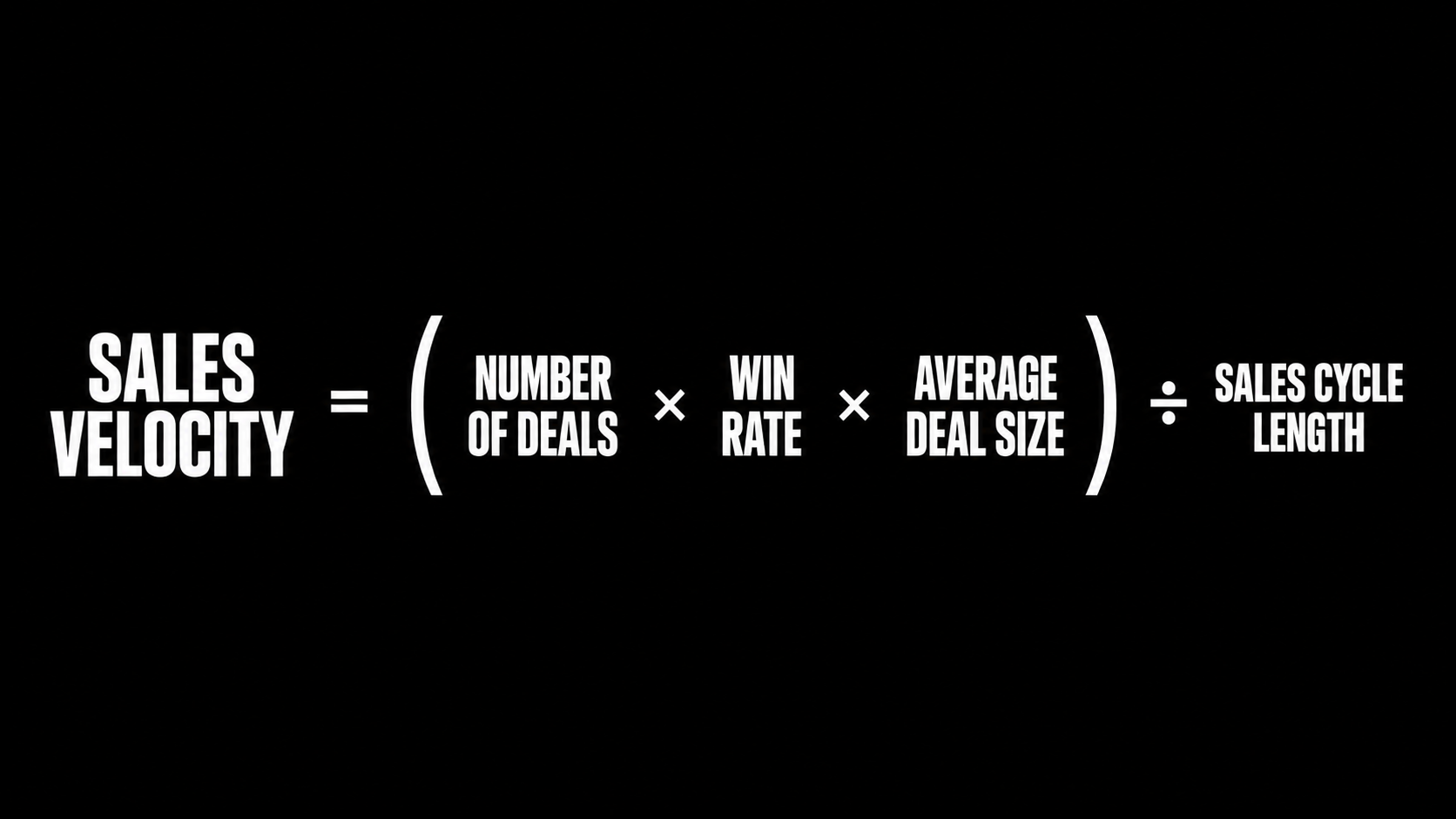
Sales velocity, also known as pipeline velocity, measures how fast money is moving through your business. This is one of the most important sales funnel metrics to track because it calculates the speed at which qualified leads turn into closed revenue.
Use this formula to calculate sales velocity: (Number of Deals x Win Rate x Average Deal Size) ÷ Sales Cycle Length.
Now, here are the sales funnel metrics to track across TOFU, MOFU, and BOFU stages.
Top of the Funnel (TOFU) Metrics
- Unique website visitors: The total volume of traffic hitting your site. It’s the rawest measure of brand awareness and effectiveness of your inbound marketing efforts.
- Lead volume: The total number of visitors who exchange their contact information for an asset. High traffic with low lead volume indicates your TOFU content is not compelling enough to drive action.
- Cost per lead (CPL): The amount of marketing spend required to acquire a single lead. Monitoring CPL ensures your demand generation campaigns scale efficiently without burning through your budget.
Middle of the Funnel (MOFU) Metrics
- Lead-to-MQL conversion rate: The percentage of raw leads that meet your specific qualification criteria. A low conversion rate here usually means marketing is capturing the wrong audience.
- MQL-to-SQL conversion rate: The rate at which marketing-approved leads are accepted by the sales team to begin active outreach. If this number dips, your marketing and sales teams have misaligned definitions of a good prospect.
- Email positive reply rates: The percentage of outbound or nurture emails that generate a favorable response. In modern sequencing, tracking this is far more valuable than tracking a vanity metric like open rate.
Bottom of the Funnel (BOFU) Metrics
- SQL-to-closed won win rate: The percentage of qualified sales meetings that turn into paying customers. This is the ultimate benchmark of your sales team’s execution and product-market fit.
- Customer acquisition cost (CAC): The total cost of sales and marketing required to win a new customer. A sustainable business keeps CAC significantly lower than the lifetime value of the accounts it closes.
- Net promoter score (NPS): A measurement of customer loyalty and satisfaction post-purchase. High NPS indicates a healthy retention stage and strong potential for expansion revenue.
Here’s How to Optimize the Sales Funnel: Fix Revenue Leaks
Knowing how to optimize the sales funnel isn’t just about pouring more leads into the top.
Optimizing your B2B sales funnel requires auditing your buyer’s journey, identifying exactly where prospects are falling out of the process, and fixing the causes.
Here are the most common revenue leaks:
Revenue Leak | Cause | Fix to Optimize Sales Funnel |
|---|---|---|
High MQL Drop-Off | Misaligned MQL and SQL definitions between marketing and sales | Create a unified scoring model on shared first-party data and strict ICP criteria |
Stalled Mid-Stage Deals | Thin MOFU content; buyers can’t evaluate the product effectively on their own | Deploy ROI calculators, in-depth case studies, and interactive demos for self-serve evaluation |
Lost High-Intent Leads | Slow follow-up by the sales team | Automate lead routing and calendar scheduling to ensure a sub-5-minute response time |
Deals Lost to “No Decision” | Single-threading; reps only talking to one stakeholder | Multi-thread the account early in the evaluation stage to build consensus among the buying committee |
High Churn Rate | Not measuring or optimizing for retention | Track NPS and expansion MRR; treat onboarding as a critical, measured part of the sales funnel |
Optimizing the B2B Sales Funnel in 2026
If you’re relying on sales reps to manually update the CRM, you’re going to get unreliable sales funnel stage data. Unreliable data leads to inaccurate forecasting, and inaccurate forecasting leads to the wrong strategic decisions. Now you’re looking at missed revenue targets.
You need a Revenue Operating System, like Reevo.
The most effective way to optimize your funnel is to capture every signal. But you can’t do this with a sales stack that just adds AI on top. You need a revenue platform with complete context, and that’s Reevo. Capturing clean, first-party data from first touch to closed won means no buyer falls through the cracks.
Give your sales team the context they need to execute flawlessly and turn your funnel into a predictable revenue engine.
Frequently Asked Questions: B2B Sales Funnel
A force multiplier for sales teams.
Get started


