Sales Execution Loss Report: Turn Lost Deals Into Coaching Moments
Reevo reviews lost deals and adds an evidence-backed reason beside your rep’s, helping sales leaders spot dropped balls and coach better follow-through.


Every CRM asks the same question when a deal is lost: Why did we lose? Most reps answer it the same way, with a couple of clicks and a dropdown.
The answers look tidy in a report: "Pricing," "Timing," "Unresponsive," and so on. Sales leaders also use them to decide whether to adjust pricing, change the pitch, or rework the process.
Few reps would choose "I dropped the ball," and it's not on the list anyway.
So we built a way to surface it. Reevo reads the calls, emails, and notes behind a lost deal and writes its own Sales Execution Loss Report right next to your rep's, including when the loss came down to something on your side.
The goal isn't to second-guess your reps. It's to give your team a clearer picture of what happened, so you can investigate it and coach to it.
How the Sales Execution Loss Report Works

When a deal with at least one meeting is marked Closed Lost, Reevo reads the calls, emails, notes, and logged activity on it and writes a short brief explaining the loss. The brief sits next to your rep's reason, and the rep's reason stays on the record.
Each brief includes:
- A primary reason, with a confidence level.
- The evidence, linked to the email or call moment behind it.
- Up to three other reasons that also played a part.
The primary reason can be timing, pricing, a product gap, poor fit, no compelling event, or sales execution. You can also add custom reasons for each pipeline in plain language, so the analysis uses the categories your team already reviews deals by.
And when the buyer really did go dark, the evidence shows that too.
Why We Built the Sales Execution Loss Report
We built this because our own CRM couldn't answer the question we cared about most after a loss: was this something we could have prevented? The dropdown told us what reps picked. It couldn't tell us what actually happened.
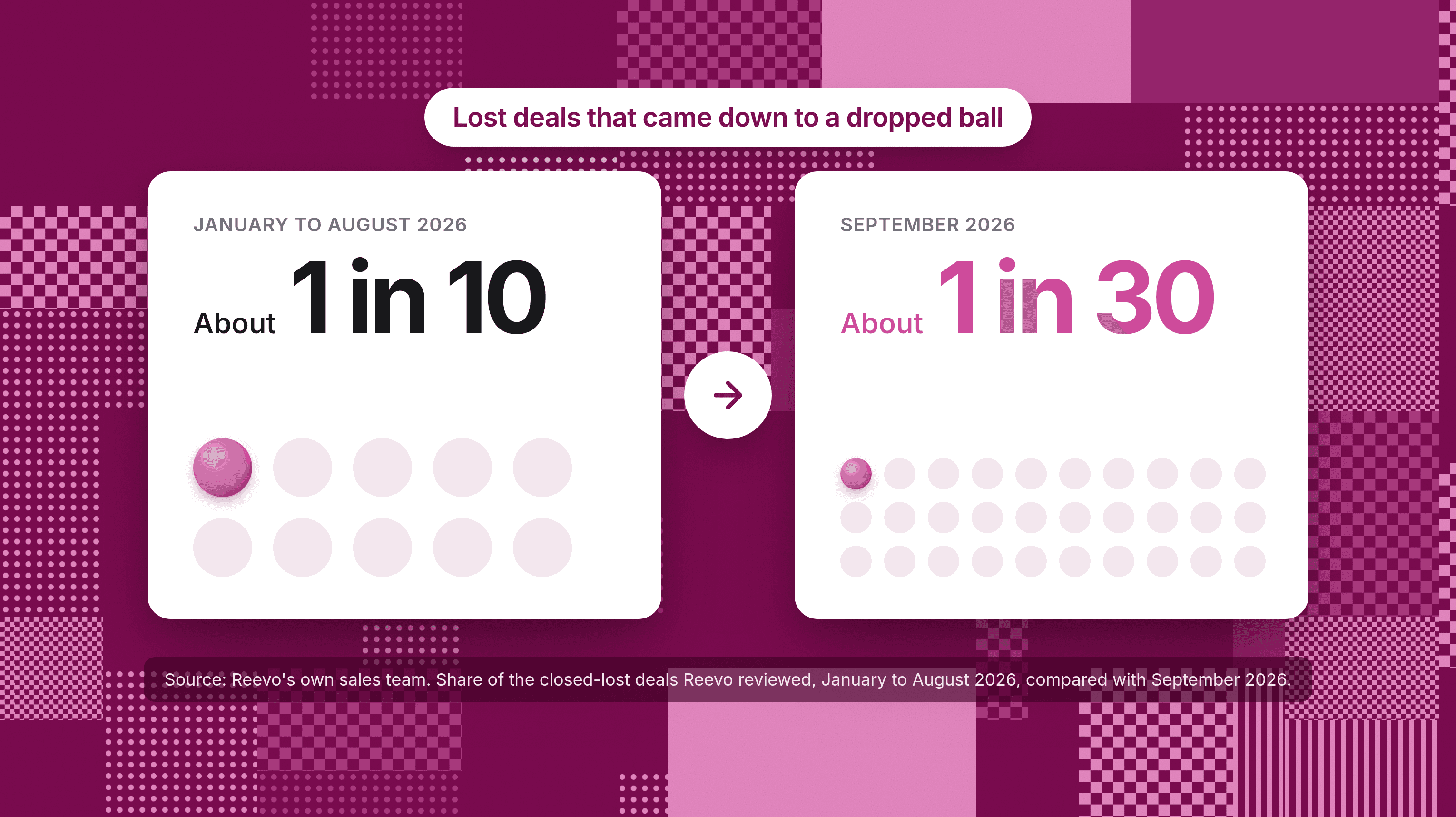
We ran an earlier version on our own team first. About 9% of the lost deals Reevo reviewed from January to August 2026 came down to a dropped ball on our side. In September, the first month we acted on what Reevo flagged, that fell to about 3%.
That's roughly 1 in 10 down to 1 in 30. None of the fixes were big. Most were habits, and habits are exactly what a dropdown can't show you.
We call this the sales execution loss rate: the share of reviewed lost deals that came down to a dropped ball on your side. It's a part of a loss your team can directly improve, which makes it a useful first question after a tough month: How much of what we lost came down to follow-through?
Here are three patterns behind those numbers, and what they taught us.
When 'Unresponsive' Means the Buyer Was Waiting
A buyer asks to meet next week. The follow-up goes out three weeks later, the buyer doesn't reply, and the deal is closed as "Unresponsive."
The label isn't wrong. The buyer did go quiet. But Reevo's brief shows the timeline: the buyer's request, then three weeks before anyone replied. The deal was waiting on us.
The coaching moment: Reply within a day or two of a meeting request, so the deal never waits on your team.
When 'Pricing' Means a Missed Offer
One deal we lost was filed under pricing. Reevo linked to the call where the buyer had asked about startup pricing, an option we offer. No one followed up with it.
Take the label at face value, and you start a pricing conversation: discounts, packaging, maybe a new tier. But the buyer never said the price was wrong. They asked a question and didn't hear back.
The coaching moment: Before you revisit pricing, check whether the buyer was still waiting on an answer.
The Calendar Link We Stopped Sending
The third pattern isn't a single deal. It's a habit. A rep wraps up a good call, sends a self-book calendar link, and moves on. It feels like a next step, but nothing is on the calendar yet, and everyone assumes the meeting will happen.
So we made a team rule to book the next meeting before the call ends, instead of sending a link and waiting.
The coaching moment: When the same miss shows up across reps, fix it once with a team habit, not deal by deal.
Start With One Deal, Then Find the Pattern
In your next one-on-one, open a recent loss, read both reasons, and follow the citations. If they disagree, that's a good place to start the conversation. Walking through the timeline together is a more useful conversation than debating which option to pick.
Reps can get there first, too. Before the one-on-one, they can review their own losses and bring the follow-up they'd handle differently next time.
Then look for patterns. One missed follow-up is a coaching moment. The same miss across several reps is a team habit, and that's where one shared rule can improve how everyone sells.
The weekly sales execution report makes those patterns easier to spot. It recaps last week's losses, highlights the deals worth a second look, and shows the patterns that keep coming up.
Open the Deal Before You Rewrite the Playbook
Lost deals take real time and effort from your team. Each one can also teach your team something about the next one.
Before you do something drastic, like cut price or rewrite the playbook based on what the dropdown says, open the deal. The fix might be smaller than you think: send the offer, rebook the no-show, put the next meeting on the calendar.
The Sales Execution Loss Report is live for every Reevo customer today. See it in action with a quick demo, and start turning lost deals into coaching moments.
A force multiplier for sales teams.
Get startedKey takeaways
- Reevo's Sales Execution Loss Report adds an evidence-backed reason beside your rep's.
- On our own team, dropped-ball losses fell from about 1 in 10 to about 1 in 30 once we acted on them.
- Use each brief to coach: Start with one deal in a one-on-one, then fix repeat misses with a team habit.
On this page
Get our newsletter, The GTM Source


